|
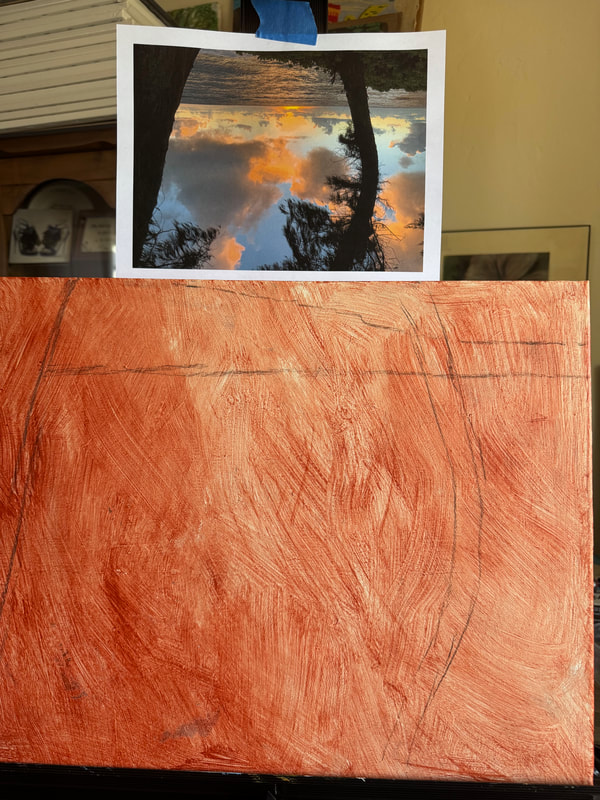
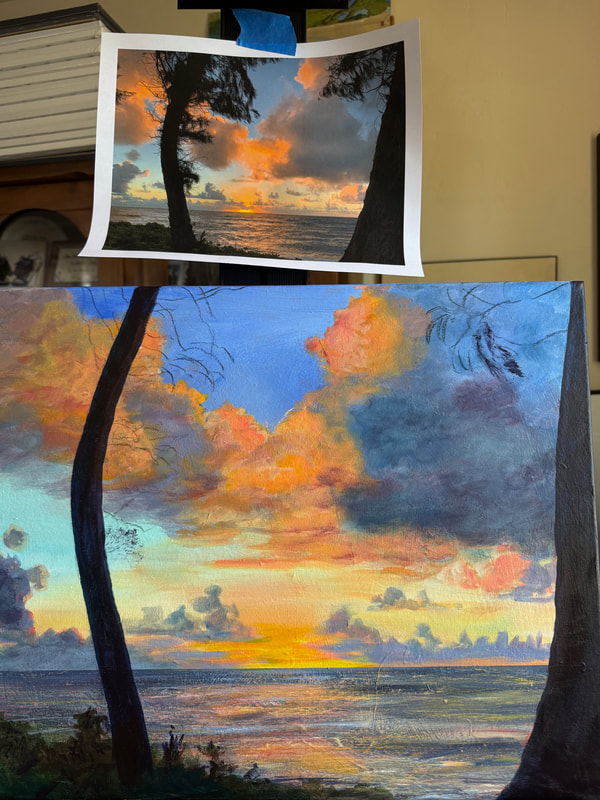
I was asked to "teach " a class on painting to beginner painters and it got me to thinking, What exactly do I tell people about that? What are the steps taken? So I decided I better give it some real thought and lay out a plan. I quickly realized there is no one plan, there is no right way. For every person who paints they have their own "ways". So for the purpose of this writing I will share my personal strategy.. A starting point is asking the question, what to paint? For me that is the first step and sometimes the most challenging part. When being asked to make a custom painting the client is the one who has the idea of what to paint and I my goal is to create a version of their vision. That in itself it a challenge. Since I am my own client I ask myself what do you want to paint? So I challenge myself to please myself and paint whatever I want. In that respect I feel painting/art is the ultimate freedom. I get to paint whatever I want and there is no one I need to please but myself! Since the first step is to decide what to paint I move on with the second step, lookin for ideas. I ask myself what interests me, what catches my attention? What pleases me visually? Does it matter if it’s been done before? Can I pull it off? What am I drawn to. For me I have always been fascinated with the light and color of water. I live near water, love to swim in water, be in a boat on water. I love to look at water scenes, beaches, lakes, rivers… So I am always on the lookout for images to paint. I take my camera everywhere and take way more pictures than needed, hoping for a good one to inspire me to paint. So my third step in making a painting is observation. Before I can attempt to paint a scene of anything I need to carefully observe it. I need to notice everything, I need to decide what to leave out or add to a scene, which is all part of making it my own. It’s part of the freedom. I observe all the elements of the subject, the sizes and shapes of items, the colors, the shadows, reflections, the subtleties in the values of colors, I just try to notice everything. After I decide what to leave in add or take out I start by looking for the dominant colors and the scene, or choose to make certain colors dominant. The fourth step in making a painting is coating my canvas with a mostly neutral color which is the opposite, or the complement of the dominant colors in my scene. I like to do this for a few reasons. I like to paint on a canvas that is not all white, it gives me a chance to just start painting without trying too hard, and I feel letting bits of the complementary color show here and there adds interest to the overall painting if that happens. For instance if my scene is mostly greens and blues I use burnt sienna a reddish-orange color. Red is the opposite of green and orange is the opposite of blue. This is not a rule but a personal choice of mine. The fifth step after coating my canvas is sketching in the basics. Sometimes I use a paper towel or wet brush and sketch in some elements by lifting up the wet background color. After that I use thin soft vine charcoal to sketch in the basic shapes and areas, starting with the largest ones first. Since I am painting with opaque paint, either oils or acrylics, all of this will be covered up later. Step 6 is what I call blocking in the basic colors. I look for the basic shapes of the colors, largest first and if I am working from a photo I can turn everything upside-down to make it easier for me to see everything without being distracted by what everything is. If I am painting from real life I squint a bit to only see the main shapes and colors. I just use loose messy blobs, no details at first. I fill the whole canvas with these background colors of the shapes. Step 7 is when I go back over everything and start adding layers of colors and a few details and smaller shapes. At this point I begin to start thinking about the colors and how I can change anything if I want to. I like to emphasize some and play down some of the colors. If something is in the distance I put less detail and use more muted colors. For the foreground I emphasize contrast and value, use brighter colors, use dark next to light, opposites near each other etc. My last step is to analyze everything and decide what I want to do to finish the painting. Sometimes acrylic paint dries a different color than when it was wet so I need to add more color. I add touches of color here and there to create color harmony and lead the eye around the painting. I change colors as needed to emphasize the complementary colors in the scene. I make my darkest darks and lightest lights and just in general try to make it sparkle with bits of color and brush strokes. If I think I am done I sign it, which for me is the hardest part. I do try to use a color and placement that fits with the painting.
0 Comments
|
NancyArchives
September 2025
Categories |





 RSS Feed